LES VOISINS
J’ai une relation compliquée avec une voisine
qui habitait pas loin, un peu plus bas,
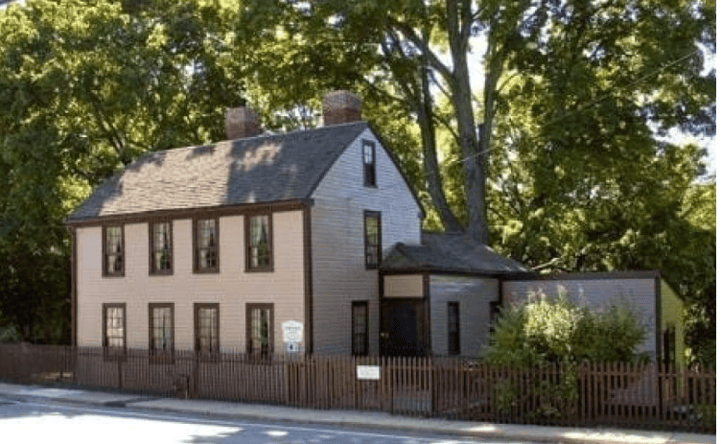
la maison beige aux fenêtres bordées de marron.
Ça fait 156 ans qu’elle a quitté les lieux.
J’ai visité sa chambre récemment,
sur les murs des coupures de journaux
racontent son histoire, ses hauts et ses bas.
D’un côté c’était une femme bien
à lire la bible sans relâche, à se battre pour joindre les deux bouts.
Mais de là à créer la Science Chrétienne, c’était culotté.
Elle cachait bien son jeu, derrière ses volets mi-clos.
Un beau jour de juillet 1868
elle est passée devant chez moi, en allant rendre visite
au célèbre poète et abolitionniste, John Greenleaf Whittier, –
mon autre voisin : j’habite entre les deux.
« Merci, Mary, pour ton appel ; cela m’a fait beaucoup de bien. »
Aurait-il toussé de son fauteuil de tuberculeux au coin du feu.
Le lendemain, il descendit au village et se portait bien.
Dit-on aussi.
Quand je passe devant sa maison, tous les jours,
je pense au bien qu’elle a fait, et au mal aussi :
un lit quelque part, où l’on a prié, au lieu d’appeler le médecin,
et quelqu’un resté là, à regarder.
Mais quelle mouche l’avait piquée ?
Si je lève les yeux vers sa fenêtre,
ou une salle de lecture de Science Chrétienne,
c’est mon doute qui me regarde, et aussi un espoir ?
* * *
NEIGHBORS
I have a complicated relationship with a neighbor
who lived not far away, a little further down,
in the beige house with brown-trimmed windows.
She has been gone for 156 years.
I visited her room recently;
on the walls, newspaper clippings
recount her story—her ups and downs.
In a way, she was a decent woman,
reading the Bible tirelessly, struggling to make ends meet.
But to go from that to founding Christian Science—that took some nerve.
She kept her true self well hidden behind her half-closed shutters.
One fine day in July 1868,
she passed by my place on her way to visit
the famous poet and abolitionist John Greenleaf Whittier—
my other neighbor; I live between the two.
“Thank you, Mary, for your visit; it did me a world of good.”
he coughed, from his armchair by the fire, with early tuberculosis—
The next day, he went down to the village, in good health.
Or so the story goes.
Whenever I pass her house—which I do every day—
I think of the good she did, and the harm, too:
a bedside somewhere, where prayers were offered instead of calling a doctor,
and someone staying there, watching.
What on earth got into her?
When I look up toward her window,
or that of a Christian Science Reading Room,
I see my own doubt staring back at me—and perhaps a glimmer of hope?
* * *
Mary Baker Eddy was a guest in this Amesbury house in the summer of 1868 and again 1870.
The house was restored by the Longyear museum, an independent historical museum dedicated to advancing the understanding of the life and work of Mary Baker Eddy, the Discoverer, Founder, and Leader of Christian Science.

